Inside this guide
 From reservation to keys: six to ten weeks for a typical resale.
This is the whole journey, in the order it happens, with numbers we can stand behind. Updated July 2026; the tax rates below are current as of that date, and where the stakes are high we tell you to confirm with your lawyer. Fix one number first: every asking price is net — taxes and fees land on top, so budget roughly 10% (resale) to 13% (new build) above the price of the home.
The purchase, step by step
Define the brief — and the area Set your budget, use and resale horizon before you view anything. Area choice moves price more than any other factor, and closed prices vary widely across the coast (see the market report and the area guides). Ben can shortlist areas to your criteria if you want a head start.
Get your NIE and a Spanish bank account The NIE (Número de Identificación de Extranjero, your foreigner ID) is mandatory: no NIE, no completing, paying tax or registering ownership. Get it via a consulate, in Spain by appointment, or through your lawyer under power of attorney — days to a few weeks. A Spanish bank account is not legally required but strongly advised for utilities, community fees, taxes and the completion transfer. Foreigners of any nationality may own Spanish property without restriction.
Appoint an independent lawyer (about 1%) Independent means not the seller's and not the developer's. Yours verifies title, charges, licences, community debts and planning, holds your deposits against conditions and can act for you remotely, for about 1% of the price. A lawyer is not legally mandatory, but skipping one is the classic expensive mistake.
Search, view and offer View no more than five or six homes a day — beyond that they blur — always book a second viewing on your shortlist, and drive the neighbourhood yourself. For apartments and plots, price per m² is a fair baseline; for villas it is one of the least reliable value guides, where location, views, plot privacy, orientation and finish matter more. A strong offer names the price, what is included, a payment schedule and a realistic completion date.
Reservation contract and fee Once your offer is accepted, a reservation contract and fee (around 1% of the price, often €6.000–€20.000) take the home off the market while due diligence runs. Read the small print: it should be refundable if your lawyer finds a genuine legal problem, and held on the seller's side, not as an agency penalty. Otherwise it is generally non-refundable — and not bulletproof, since a seller can occasionally still take a stronger offer and return it, which is why you move quickly to the private contract.
Due diligence While the reservation holds the home, your lawyer runs three checks in parallel — legal, planning and technical. This is where bad purchases are caught; see due diligence below for the traps that matter on this coast.
Private purchase contract (arras) — 10% Usually two to four weeks after the reservation, the private purchase contract (contrato de arras) is the real lock-in: you pay 10% (less the reservation) and the completion date is fixed. The penalties now bind both sides — pull out and you lose the 10%; if the seller pulls out they return double. It is normally conditional on due diligence, so serious findings let you withdraw and recover your deposit.
Mortgage, if you need one Non-residents typically finance 50–70% of the price depending on bank and profile. Start at reservation: valuation and approval add three to five weeks and must land before the notary date. See financing below — and note that most prime purchases here are cash.
Completion at the notary — and the days after The deed is read and signed, the balance (the remaining 90%) is paid, and you get the keys. Your lawyer then settles the purchase tax within 30 days, registers the deed (about a month at the Land Registry) and switches IBI, community fees, utilities and insurance to your name. If you might let short-term, sort the licence before you rely on the income — see due diligence.
How long it really takes
A typical resale completes in six to ten weeks from reservation — as little as four in cash, ten to twelve with a non-resident mortgage. Drumelia frames it as about three months from accepted offer to notary (Drumelia, September 2025). Off-plan is different: it follows the build calendar, not a count of weeks.
| Milestone | Resale | Off-plan / new build |
|---|---|---|
| Reservation to private contract | 2–4 weeks | Signed with a bank guarantee |
| Private contract to completion | 1–2 months | Staged over the build (18–30 months) |
| Whole purchase | 6–10 weeks (cash from ~4) | 1–3 years to move-in |
| After completion | Tax within 30 days; registry ~1 month | Same, plus snagging |
Purchase tax — ITP on a resale, or VAT plus stamp duty on a new build — is due within 30 days of completion, and re-registration in your name at the Land Registry takes about a month (Drumelia, September 2025). Your lawyer normally handles both.
What it costs
Every price is net. A resale carries 7% ITP (transfer tax); a developer new build carries 10% VAT (IVA) plus 1.2% AJD (stamp duty) — both Andalucía-specific and current as of July 2026, and Andalucía's flat 7% is among the lowest coastal rates in Spain (Catalonia and Valencia charge 10–11%). Add the lawyer (about 1%) and notary and registry (€2.000–3.500), and all-in you budget the price plus roughly 8–13% on a resale and 12–14% on a new build (Drumelia, Bromley and our own figures, 2025–26). On a €750.000 resale that is about €813.000 (+8.4%); as a new build, about €844.500 (+12.6%). The agency commission is paid by the seller in nearly all Costa del Sol deals, so you should not pay one unless you deliberately engaged a buyer's agent.
The costs guide has the full breakdown — running costs, non-resident income tax, the reduced 2% investor rate and its 2026 tightening, and a live calculator. Budget the exit too: the selling guide covers the 3% retention and plusvalía municipal you meet when you sell.
 Most of a purchase is decided on the terrace, long before the notary's office.
Due diligence: where deals are saved
While the reservation holds the home, your lawyer runs three checks at once (Drumelia, September 2025):
Legal — ownership, debts and liens, community charges, registration and inventory. The nota simple (Land Registry extract) confirms who owns the home and what charges sit against it; your lawyer also checks IBI is up to date and community fees are cleared.
Planning — compliance, the Licence of First Occupation, irregular extensions and town-hall certificates. For an apartment, whether the community was legally built and licensed; for a villa, the house as built against the original approved plans.
Technical — structure, plumbing, electrics, heating and cooling, condition, and a realistic renovation budget if you plan changes.
The traps that matter here
A missing Licence of First Occupation (LPO). Many Marbella homes built in the 2000s lack a full LPO because developers slightly exceeded the permitted building volume. They are still lived in, resold and mortgaged — but it can affect financing and rental licensing, so it belongs in due diligence.
Basements used as bedrooms. In villas, rooms officially registered as "storage" are very commonly used as bedrooms, gyms or cinemas. Usually harmless, but check and understand it before you sign.
Extensions. Above-ground and recent additions are more sensitive than basements: recent unauthorised work can cause serious problems, and older work may limit what you can build later. Your lawyer should obtain a town-hall certificate of no infractions, which can take months — so build the timing into your contract.
If your plans depend on short-term letting, check it before you buy. Andalusian holiday lets need a VUT tourist licence registered before you advertise, and since April 2025 the homeowners' community can vote to restrict or block new tourist lets — so a licence is not guaranteed, and the yield you counted on may not be there.
Buying off-plan and new-build
Off-plan can mean a lower entry price (often below the current market), capital growth during construction and wider choice in a new complex. It also carries more risk and is rare in the most established prime areas, where resale dominates. Three safeguards are non-negotiable:
A bank guarantee on every stage payment Spanish law requires your instalments to be protected by a bank guarantee, so your money is returned if the project fails. No guarantee, no payment.
A valid building licence before construction instalments Confirm the licence exists before any money tied to construction leaves your account.
Completion with the Licence of First Occupation The LPO confirms the finished building is legal to occupy — the same document whose absence trips up so many 2000s resales.
Delays of six to twelve months are common even on solid projects. Your protection is the bank guarantee on every stage payment plus a clear long-stop completion date written into the contract.
On handover, walk the home with a snagging list — paint, leaks, heating, every appliance, tap and switch — before you sign it off. Stage payments spread over 18–30 months, and Drumelia puts move-in at one to three years from purchase (Drumelia, September 2025).
Financing as a non-resident
Most prime purchases here are cash: fewer than 10% of purchases above €2 million are financed (Panorama market report, Christopher Clover, April 2026), which is why the top of the market barely flinches when rates move. If you do borrow, non-residents typically finance 50–70% of the price depending on bank and profile — Benalto's experience sits at 60–70%, while Drumelia cites around 50% for non-residents and up to 80% for residents (Drumelia, September 2025). The loan is set on the lower of the purchase price or the bank's valuation, so a cautious valuation reduces what you can borrow.
A typical non-resident rate in 2025 was around 3.3% (Drumelia, 2025); the 12-month Euribor most variable loans track sat near 2.7–2.8% in July 2026 and is not expected to fall before 2027 (Idealista, July 2026), so budget on today's rates. The only real extra cost to arrange the loan is the bank valuation — roughly €300–600, up to €4.000 at the ultra-prime end (Drumelia). Since 2019 the lender pays most set-up taxes, home insurance becomes mandatory with a loan, and on completion day two deeds are signed together — purchase and mortgage.
Currency
Buying in euros from another currency, exchange is usually worth 1–3% of the price to get right. Banks price international transfers with wide spreads; a specialist currency broker typically does better and can offer a forward contract to lock the rate between deposit and completion — on a €750.000 purchase that spread is real money. A weaker pound raises the entry cost for sterling buyers, but prime appreciation of roughly 7–10% a year has outpaced currency friction over five-to-seven-year holds (Bromley, May 2026).
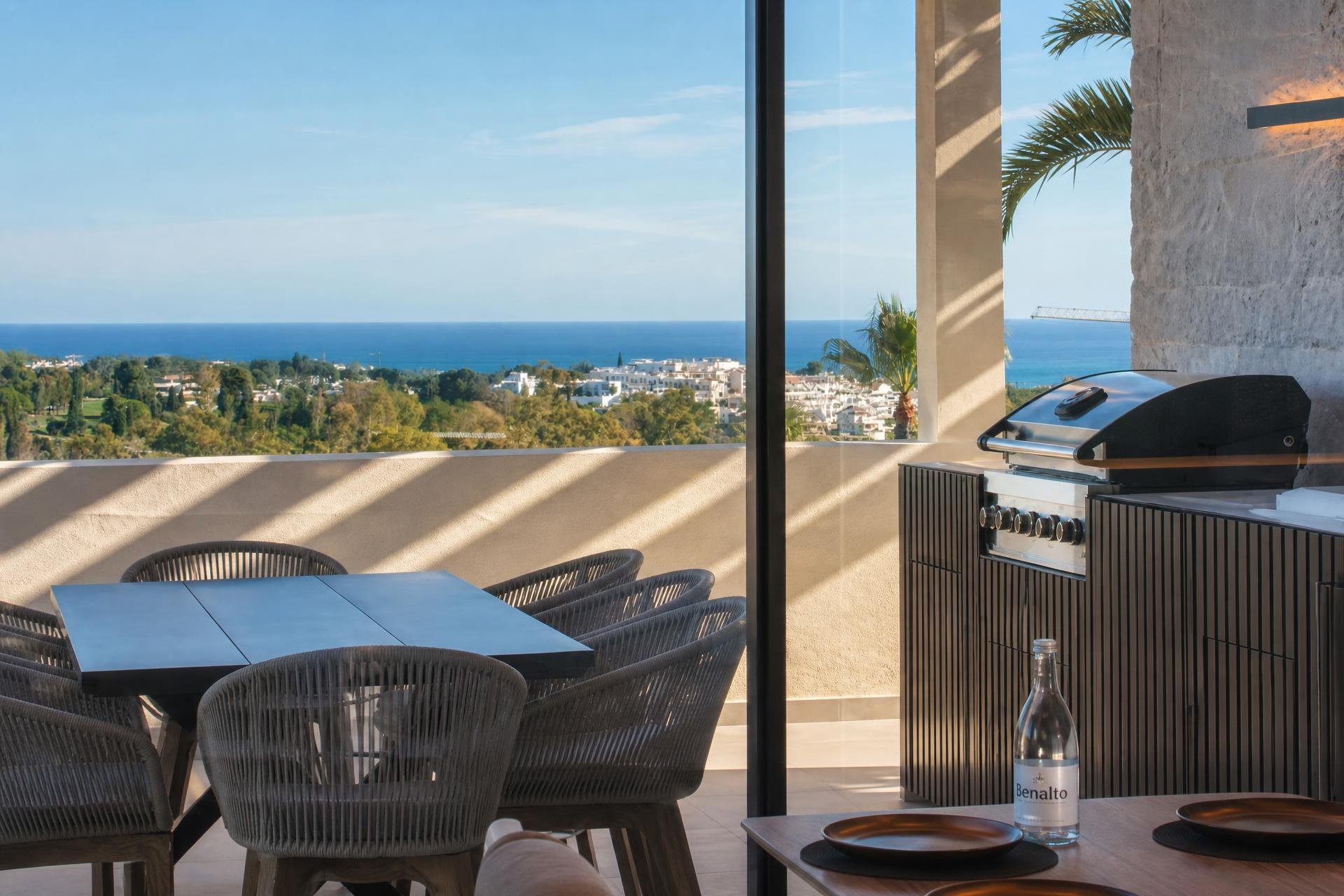
 What a viewing has to tell you is how the light falls, and at what hour.
Buying from abroad
You do not need to be in Spain to buy. With a power of attorney, your lawyer can obtain your NIE, run due diligence, set up banking and sign the deed on your behalf — many buyers complete remotely and collect the keys on their next trip. The sensible caveat, especially at the top of the market: make at least one in-person visit before you commit (Drumelia, January 2026). A video tour is a shortlist tool, not a substitute for standing in the room.
On residency: buying no longer grants it. The Golden Visa investor route closed on 3 April 2025, so a purchase is a property decision, not an immigration one. Spending 183 days or more a year in Spain can make you tax-resident, which is why many international buyers stay non-resident (Drumelia, September 2025). At completion the safest payment method is a banker's draft from a Spanish bank, and sellers almost always refuse to hand over keys before the deed is signed.
Rent with option to buy
Occasionally a home is offered on a rent-with-option-to-buy basis, which suits a buyer who wants to move in now and complete later. The usual shape: pay 10–20% up front alongside a rental contract, take the keys immediately as a tenant, and pay the balance in staged instalments (every three to six months, or annually) with the rest at the notary, inside a window of roughly one to two years. Part of the rent may or may not count toward the price — a point to negotiate. The clause that makes it work for the seller is strict: fail to complete and you lose everything paid and must vacate. Have your lawyer read it as carefully as any purchase contract.
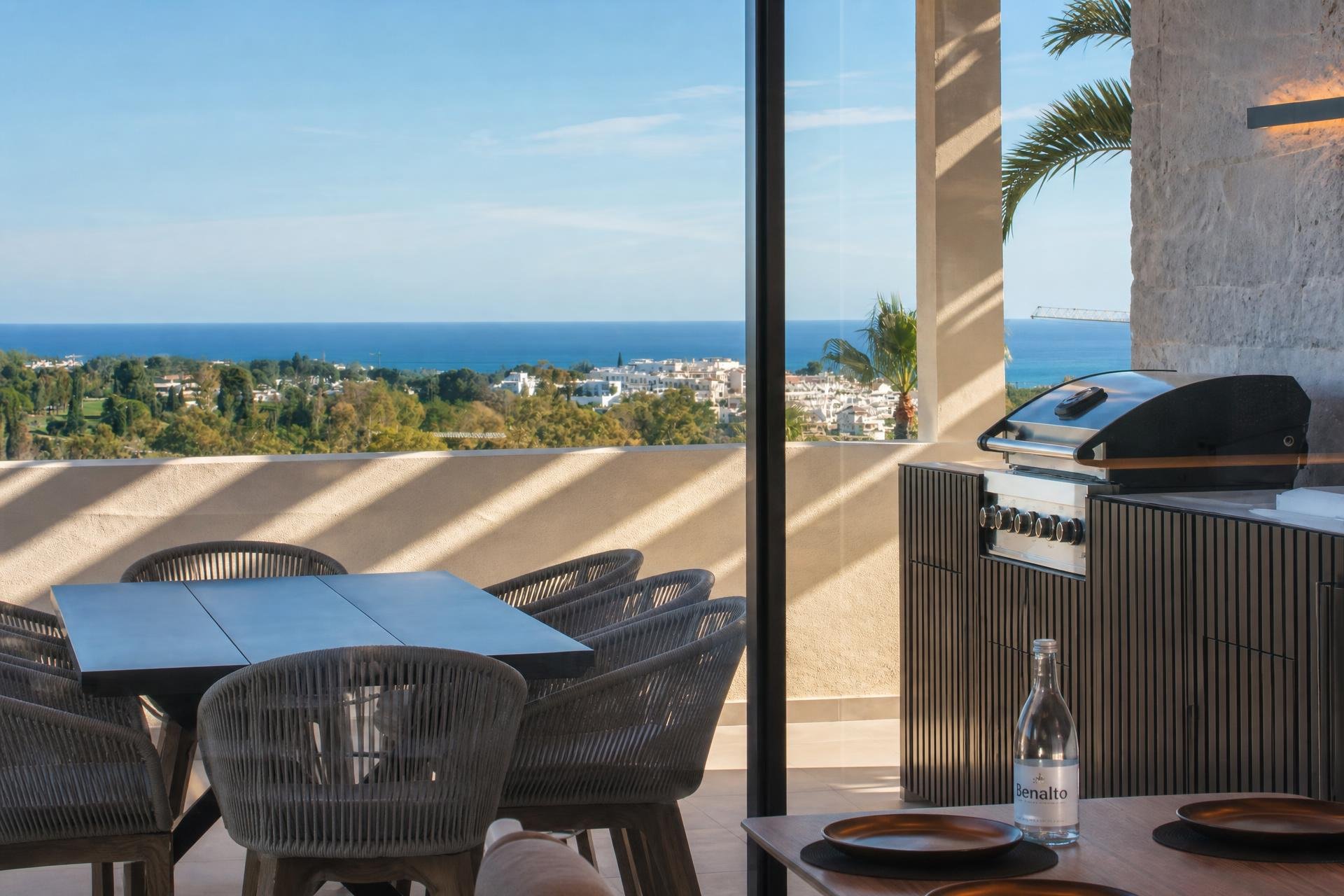
 Three figures pause on a terrace at golden hour, the coastline laid out below them.
Negotiation and the real closing price
The most useful numbers we can give you separate what sellers ask from what homes actually change hands for. Since Spain's Notaries' Portal began publishing municipal deed prices, the picture is clear. In Q1 2026, achieved (notarial) prices across the Golden Triangle were €4.864/m² in Marbella, €4.718/m² in Benahavís and €3.384/m² in Estepona — all up year on year, even as transaction volumes fell in all three (Notaries' Portal via Knight Frank, reported July 2026).
Set those against asking prices from the same period. In Estepona, portal listings averaged €4.234/m² in February 2026 against that €3.384/m² of closed deals — roughly a 25% asking-to-closed gap (Idealista and Notaries' Portal via Knight Frank, early 2026). Prime Marbella asking prices keep setting records — Nueva Andalucía listings hit €5.654/m² in February 2026, an all-time high (Idealista) — which is why the deed data matters: the headline listing number is a starting position, not the price.
Always separate asking from closed prices. Portal averages describe hope; notarial averages describe what buyers and sellers actually signed. We quote both, and we price against the second.
The biggest lever is not how hard you push — it is how prepared you are. Sellers routinely pick the most serious, ready buyer (NIE in hand, lawyer appointed, funds confirmed, a clear timeline) over a slightly higher but uncertain offer. The classic mistakes run the other way: negotiating directly with the seller, squeezing for small discounts, and moving too slowly on paperwork. Use one trusted agent rather than several — on this coast most agents reach the same broad pool of listings, so the difference is service, response and negotiation, not who "has" the property.
The backdrop still favours sellers: nationwide listings fell 20% year on year to June 2025, the biggest drop Idealista has recorded, and though the contraction eased through 2026, supply stays far below demand (Idealista via Panorama, 2025–26). For live figures see the market report; to weigh areas, the Marbella, Nueva Andalucía and Estepona guides go deeper.
When you are ready to move from reading to doing, tell us your brief and we will line up the team — lawyer, viewings and honest numbers on every home. Above €3.7 million, bring a tax adviser in from the first conversation: net wealth over that threshold can attract Spain's solidarity tax.